Knowledge Pathways

The subjects I write about may seem far apart at first, but I do not see them as separate worlds. Leadership leads to people, people to education, and education to questions about the future. Media leads to awareness, which connects to society and power. The present cannot be understood without history, while artificial intelligence now cuts across all these fields and raises their questions anew.

The following pathways are therefore different entry points into a single intellectual undertaking, rather than boundaries that divide knowledge into separate islands.

Why I Write

I write because an idea that stays in the mind may be lost. Once it becomes words, it begins a new life: someone else can read it, discuss it, disagree with it, or build on it to create an idea that did not exist before.

I write because writing helps me understand. What seems clear in the mind can reveal previously unseen questions, contradictions, and relationships when put into words. In trying to articulate an idea, I have to test it, give it structure, and look for what supports it or calls for reconsideration.

I also write because some things may disappear if they are not documented in time. Events, memories, experiences, names, photographs, and documents are not guaranteed to survive. Preserving them means giving the future a memory it can return to, rather than clinging to the past.

I do not write to offer final certainty or ask readers to see the world as I do. I write to open a shared space for questions and thought, because I believe knowledge becomes more valuable when it is accessible, and when it develops from an individual experience into a dialogue in which others can take part.

Leadership and Management

Leadership is rooted in my advanced academic specialization and my early interest in human and organizational behavior in the workplace. This journey began with the study of altruism and civic virtue at work, and the questions they raise about behavior that goes beyond formal duties, cooperation, trust, responsibility, and initiative. How can institutions create environments in which people work not simply because they must, but because they feel a sense of belonging and responsibility toward their colleagues and the institution?

This interest in people within institutions developed into an inquiry into leadership itself. In ethical leadership, success depends on how results are achieved, not on results alone. Fairness, integrity, trust, responsibility, and respect for people are not peripheral values; they shape a leader’s legitimacy and an institution’s ability to endure. The inquiry then turns to intelligent leadership in a more complex environment, where technology, data, artificial intelligence, distributed knowledge, and rapid change have become integral to work. Leaders must anticipate the future, work with data, use technology, draw on others’ knowledge, and continue learning and adapting, while retaining human judgment and an ethical compass.

Balanced leadership adds another dimension. Institutions face continuing tensions between the present and the future, performance and people, stability and change, efficiency and innovation, firmness and flexibility, authority and participation, data and experience, and results and values. Balance becomes a leadership capability: the ability to manage these competing demands rather than consistently favor one side. Ultimately, the question is how to build institutions that achieve results without losing sight of the people who make their success possible.

Education and the Future of Learning

Education is one of the broadest and most sustained strands of my writing. I approach it as an ongoing inquiry into what learning means in a changing world. When knowledge was difficult to access, acquiring and retaining information was central to achievement. That environment has changed: knowledge is now within reach, and artificial intelligence has made answers easier to access, analyze, and summarize. This raises a more fundamental question: if obtaining information is no longer the central problem, what should education do?

One strand of this work began with intelligent and personalized learning, and the possibility of making education more responsive to learners’ differing abilities and needs. It then extended to online and blended learning, and the ways technology has changed where, when, and how people learn. The inquiry broadened to encompass higher education, quality, academic accreditation, and global rankings, then educational foresight, twenty-first-century skills and competencies, reading and writing, homeschooling, and personal and sustainable learning.

These subjects share a question that reaches beyond schools and universities to the nature of learning itself. If today’s students will live and work in a world whose details we do not yet know, education cannot simply prepare them for the next examination. It must develop their ability to think, learn, adapt, solve problems, and work with others. The shift we need is from education focused on transmitting knowledge to learning that develops people’s capacity to learn independently.

Human Intelligence and Capability Development

At the heart of education, leadership, and work lies a question that precedes them all: how do people themselves function, and what enables them to succeed, adapt, and relate to others? Success depends not only on what people know or the qualifications they hold, but also on their ability to understand themselves and others, put knowledge into practice, and navigate situations that offer no ready-made answers.

This led to my interest in emotional intelligence, successful intelligence, and practical intelligence: concepts that broaden our understanding of intelligence beyond cognitive ability or academic attainment alone. My focus then moved from the individual to the group through collective intelligence. Modern institutions depend on knowledge distributed across people, disciplines, and areas of expertise. The challenge is to turn that dispersed knowledge into a collective capacity to understand, make decisions, and solve problems.

The question thus extends beyond developing any single skill. It concerns how to help people understand themselves, engage with others, learn from them, and renew their capabilities as the world around them changes.

Media and Digital Transformation

Historically, media operated through a limited range of channels controlled by a relatively small number of institutions. Digital transformation changed that entire structure. Individuals became audiences, producers, and publishers at the same time, and the relationship between media institutions and their audiences shifted. Platforms and algorithms then began determining, to varying degrees, what reaches users and what does not. For me, media is therefore more than a means of delivering news: it is an environment that helps shape knowledge, identity, culture, and social perceptions.

From alternative media and its relationship with education and social identity, to social media, and then to the future of media in the age of digital transformation and artificial intelligence, my inquiry has moved from the medium to the media environment itself. Who creates a message? Who distributes it? Why does it reach one audience rather than another? What happens when audiences become publishers themselves, and when machines can produce text, images, audio, and video, analyze content, and deliver it to audiences?

The question is no longer only what media communicates, but what happens after a message arrives. This is where media connects with awareness, influence, and the shaping of reality.

Awareness, Influence, and the Shaping of Reality

From Manufacturing Hype to Shaping Systems

This pathway began with an apparently simple question: why do certain ideas, products, people, and phenomena spread so widely, while other ideas pass without leaving the same impression? Exploring that question gradually took me far beyond trends or fleeting fame. Widespread attention is only the first layer of a more complex phenomenon involving the shaping of convictions, the creation of value, the construction of legitimacy, and the realignment of interests. Some ideas can develop from a passing wave into an enduring structure that influences society, politics, economics, and culture.

The first volume of (Secrets of Trend Making) focuses on how hype takes shape and spreads. How can a simple idea, an image, a person, a product, or even a carefully constructed illusion become a collective phenomenon that attracts attention and comes to be seen as valuable? The book explores the tools that drive trend, audience psychology, and the mechanisms of imitation, attraction, and engagement that sometimes make people want something because others want it, or take an interest in a subject because everyone is talking about it.

Understanding how Trend spreads is not enough, however. The second volume therefore moves from asking how Trend spreads to why it is manufactured, who is behind it, and who benefits from its persistence. Trend shifts from a mass phenomenon to a potential instrument of power and influence. Interests enter the picture, and legitimacy, values, impressions, and narratives become part of a wider process through which awareness can be reshaped. This volume reveals the difference between the visible face of Trend, which audiences see and engage with, and the deeper structure in which interests, power, and the production of legitimacy operate.

The third volume of (Secrets of Trend Making) takes the project to its deepest level: how does Trend become a system? Some waves of Trends outlast their initial spread and even the actors or interests that helped create them. They become embedded in society as an idea, a rule, an institution, or a system of values and practices that, over time, appears natural and self-evident.

At this point, the meaning of Trend changes fundamentally. It is no longer simply an event that draws people in or a tool used by an actor to achieve a particular goal. It has become a structure capable of reproducing itself. Institutions, interests, discourses, elites, laws or conventions, and ways of thinking and interpreting emerge around it. The new system then begins to produce the conditions for its own continuity. What began as an idea that needed to persuade people eventually becomes a reality that defines what they regard as acceptable, normal, and possible.

From here, my research expanded to (Battles for Minds in the Digital Age), and then to (Online Trolls, Digital Armies, and the Manufacture of Disinformation). The focus became the shaping of perception itself: how narratives can be produced, amplified, and repeated, how impressions are created, and how the public’s view of reality can be influenced. The journey thus moves from manufacturing attention to building influence, and then to shaping a system and a reality that reproduce themselves.

Society, Culture, and Changes in Human Life

Major transformations are not remote from everyday life. Every technological, media, or economic change can have effects that extend beyond the tool or event itself to relationships, values, habits, language, identity, and the way people see themselves and others.

This led to my interest in how mobile communication devices affect social and family relationships. They reveal a paradox: tools that increase our ability to connect can also reshape the meaning of presence, communication, privacy, and relationships within the family. This interest extends to social media and the changes it has brought to patterns of interaction, expression, relationship formation, and the image people present of themselves to others.

The same question emerges from another angle in art. Art does not exist outside society, and its role extends beyond entertainment or the creation of beauty. It can reflect a society’s values, changes, and tensions, while also helping to shape awareness, taste, identity, and the image through which society imagines itself.

Society and culture thus offer a way to understand the changes that sometimes unfold quietly within everyday life: how tools, ideas, art, and communication media change the way we live together, and how people are shaped by their society and, in turn, help reshape it.

Artificial Intelligence and the Future

Artificial intelligence differs from many earlier technologies because it enters areas we have traditionally associated with the human mind: writing, analysis, translation, design, research, content creation, and support for decision-making. In one of my publications, I explored ChatGPT’s capabilities, uses, and potential effects on professions, life, and work. Yet the question has grown larger than any single tool.

Artificial intelligence revisits the questions driving most of my research pathways. In education, it asks what we should learn when machines can provide answers. In leadership, it prompts us to rethink the relationship between data, human judgment, and responsibility. In media, it raises new questions about truth, trust, and synthetic content. At work, it changes the value of some skills and increases the importance of others. In art, it reopens the question of what creativity means. In the sphere of awareness and influence, it multiplies the capacity to produce messages, images, and narratives, and to exert influence on a large scale.

I therefore approach artificial intelligence as a transformation that cuts across fields of knowledge and ultimately brings us back to a question about human beings: as machines become more capable, what should we become better able to do?

History and Documentation

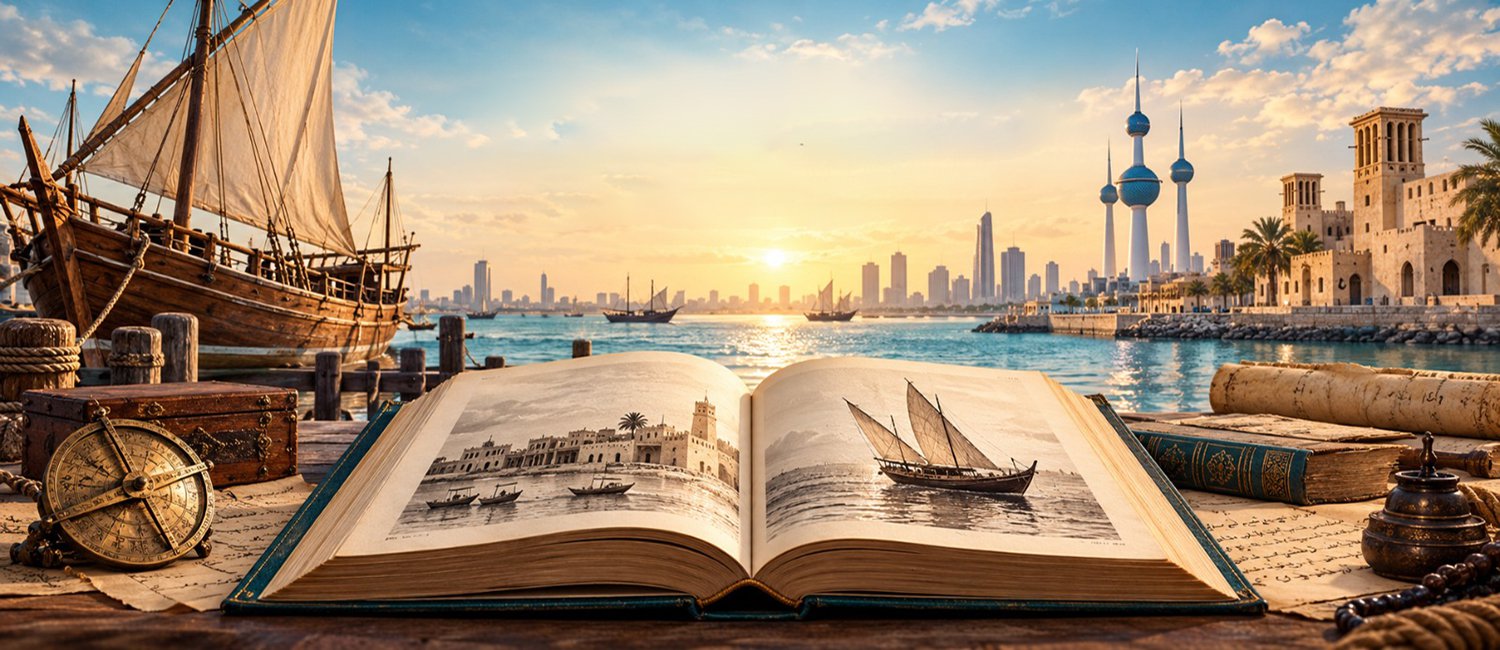
I see history as a memory that helps us understand how we arrived at the moment we inhabit. Behind every place is a story; behind every institution, a beginning; and behind every transformation, people, decisions, and circumstances whose details may be lost if no one documents them.

This is the source of my interest in Kuwait’s history, its people, its places, and its milestones. It is reflected in works including (The Majlis Gatherings of Kuwait’s Rulers through the Eyes of Western Travelers), (King Abdulaziz’s Life in Kuwait), (Al Mulla in the realms of History and Politics), and (Al Safat Square), among others. These works approach history through people, places, documents, photographs, and accounts.

For me, documentation is not about preserving the past for its own sake, but about protecting memory from loss. New generations need to know how things began, who brought them into being, and the circumstances surrounding them. Our understanding of the present deepens when we know the path that led to it.

This same idea gave rise to encyclopedic and documentation projects that seek to move beyond a book ending on its final page toward an evolving body of knowledge. Such a project can grow as new documents, information, and stories emerge. The question guiding this pathway is: what will remain of our history if no one preserves its details before they disappear?

Major Projects

Some Ideas Need More Than One Book

Some projects begin with an idea but expand through research until they become difficult to contain within a single book. They may engage with an evolving memory, a long history, or a body of knowledge that can keep growing whenever new information, documents, or stories come to light.

Encyclopedic projects emerged from this need as a distinct space for research and documentation. They do not end with the publication of an edition, but remain open to additions, development, and revision.

Encyclopedia of Kuwait’s Pioneers

Behind Every First Is a Story Worth Telling

Encyclopedia of Kuwait’s Pioneers seeks to preserve the memory of Kuwait’s pioneering achievements by documenting the people, institutions, events, and accomplishments associated with something happening for the first time. It goes beyond recording names and dates. A first is more than an entry in a chronology: it is a moment of change, when a person, an institution, or an endeavor opens a path that did not previously exist.

The encyclopedia therefore asks: how did the story begin? What came before it? What circumstances made this achievement possible? Why was it distinctive in its time? And what changed afterward?

The encyclopedia spans many areas of Kuwait’s history, its people, institutions, and achievements in education, medicine, media, culture, art, science, economics, trade, sports, and other fields. It brings together information, context, documents, photographs, and human stories, so that an achievement remains connected to the person who made it possible.

It is an evolving encyclopedia by its very nature, because the story of pioneering achievement never stops. Just as Kuwait had its firsts in the past, new firsts are emerging today, and others have yet to be achieved. The project therefore treats the past as a starting point that can inspire new generations to create beginnings of their own, rather than as the end of the story.

A history to be proud of, and a future whose firsts are still waiting to be made.

The Comprehensive Encyclopedia of Art and Media throughout Human History

The Human Story Told through Images, Words, and Sound

Encyclopedia of Art and Media throughout Human History traces humanity’s relationship with expression and communication through successive stages of its development. It begins with the idea that people have never been content simply to live their experiences: they have always sought to express them and leave a record that others can encounter. The tools of expression and communication have changed with civilizations and technologies, but the human need to express and connect has endured.

The encyclopedia brings art and media together because both involve messages, media, audiences, memory, and influence. It explores how the ways people express themselves and convey their ideas, images, and values have changed, through to the digital environment and artificial intelligence.

The project combines a historical chronology of the emergence of different media with a reading of human history through our means of expression and communication. It explores how those media changed both people and society, how messages moved from a limited circle to a mass audience, and then into a world where anyone could become a content creator, eventually reaching a stage in which machines themselves participate in producing content.

From Question to Book

Some ideas can be explored in an article. Others need a longer journey of reading, research, comparison, and reflection before taking shape as a book. That journey often begins with a question that stays with me, growing as new details and relationships come into view.

I begin by gathering what might help me understand the question, then explore its roots, contexts, and transformations, testing the idea from more than one perspective. A team of specialist researchers joins me in this journey, helping to gather material, trace sources, broaden the inquiry, and verify details. Their contribution enriches the work, extends its scope, and helps it progress more quickly without compromising the depth or rigor of the research. A book may change direction as the work unfolds, because research does not always lead to the outcome we expect at the outset. Over time, the scattered material begins to form a clearer structure: questions become chapters, and chapters become a path the reader can follow.

I do not see a book as the end of a question. It may give an idea a framework and bring together what I have reached at a particular stage, but it also opens further questions. It may lead to a new article, a study, another volume, or a broader intellectual project. This is why, despite their different subjects, I see my books as parts of a single journey that always begins with a desire to understand.

Articles and Research

Articles give me room to explore a current idea or a specific question, and to reflect on what is happening around us before it passes without examination. Research offers a slower pace and greater depth for gathering material, analyzing it, comparing perspectives, and building a more coherent understanding.

This section brings together my articles and research on leadership, education, human experience, media, awareness, society, history, and artificial intelligence. They are different attempts to understand people and the world they shape and are shaped by. Some texts may extend a book, mark the beginning of an idea that will later grow, or offer an independent exploration of a phenomenon that deserves closer attention.

I write articles and research to share the process of thinking with readers, not just its conclusions, and to invite them to consider a question from perspectives that may not be apparent at first. Knowledge advances through questions that help us see the familiar differently.

Training and Knowledge Sharing

Knowledge realizes its full value when it becomes dialogue, experience, and practice that help people understand and develop. Training is therefore a natural extension of research and writing: a space where ideas become discussion, application, and an exchange of experience.

My training programs and sessions draw on the subjects that shape my work, including leadership, education, capability development, manufacturing hype, media and digital transformation, awareness, and artificial intelligence. They connect concepts with the questions and challenges participants face, opening up space for reflection, participation, and reconsideration of established practices.

I believe that knowledge sharing is not a one-way process from trainer to participant. Every encounter brings different experiences and questions, and gives everyone the opportunity to learn from one another. I therefore aim to make training the beginning of learning that continues after the program ends, rather than material whose relevance ends with the session.